Discovery of the day.

I have tremors. Often enough they are severe enough to make walking to the table with coffee without spilling it difficult. So today, I finally figured out…

Putting whipped cream on top of the coffee makes it less likely to slosh out of the cup.

I wonder what whiskey will do?

Posted in nothing special | Leave a comment

If you had told me a couple of years ago I would be listening to rap music, I would have told you you were crazy. Rap was okay, but it wasn’t music, was it?

That was before Hamilton (which at least one of my sons thinks isn’t really rap). (It was Broadway, so it didn’t really count for him.) More to the point, that was before the Hamilton Mixtape. The Red-Headed Menace was poo-pooing it — until I said that Nas was on it, and Wiz Khalifa, as well as a number of other rappers he deemed “legit.”

The show and the Mixtape break down the oddest barriers. Otherwise, I would never have sat in a San Francisco theater, waiting for the curtain to go up, talking to a white suburban woman my age about… Kendrick Lamar’s latest album, and whether it was better than To Pimp a Butterfly. And leaving me with a feeling that I was missing a lot — mainly other people’s experiences — by not listening to more rap.

Much more than the play itself,  some of the songs on the Mixtape speak truth to power. It gives us messages we desperately need to hear.

I like a lot of the non-rap numbers on the Mixtape (Usher’s “Wait For It,” Alicia Keyes “That Would be Enough,” and the absolutely devastating “It’s Quiet Uptown” by Kelly Clarkson.) But my favorite song — as I mentioned in the previous post — is “Immigrants Get the Job Done,” by K’naan, Snow, Tha Product, Riz MC & Residente. The song names what is worst in this country — and by us, I mean white, xenophobic America, willing to look the other way as “Immigrant becomes a bad word.” And yet, in the song’s righteous anger, I find hope: “America’s ghostwriters” do get the job done, and the rest of us may yet come to realize that opening our arms to people coming to our shores and over our borders will make us stronger.

Rap music — like other music — has the potential for power. It can open eyes and change minds. I need to listen to more of it.

Posted in Culture (popular and otherwise), Music | Tagged | Leave a comment

“We’re America’s ghostwriters.”

My favorite piece from the Hamilton Mixtape.

I wish I could send this to every member of Congress and the Administration.

I know, however, that the people most in need of a change of heart will not be swayed by it, if they bother to watch it at all.


Posted in nothing special | Leave a comment

Perspective.

While I am recovering, I am watching a lot of television (but no news). Today’s feature: the last day of the Royal Ascot race meeting in London. Talking about the weather, the announcer said “Still quite warm here — 73 degrees, and very humid…”

73 degrees is “still quite warm”? Oh, England, how I love thee.

Posted in nothing special | Leave a comment

Gaudi.

Every so often there comes an artist who changes how you think about art, about the world, about life. Artists whose works were beloved when they were alive and artists who were only appreciated after they were dead. Leonardo, Cervantes, Emily Dickenson, Lennon & McCarthy, Stephen Sondheim. Vincent Van Gogh.

Antoni Gaudì.

I often repeat the axiom that you cannot properly assess a work of art from a photograph (see: “Guernica”). I had seen pictures of Gaudi’s work before, and while some were merely much better than their photos, at least one is truly transcendent. It touched my soul in indescribable ways.

Let’s take them in order of preference:

Casa Mila. Rick Stevens says this may be the most photographed building in Barcelona. He may be right. People often describe Gaudi’s facade for this building as “melting,” although to me it more resembles sand dunes. The interior has a wonderful light well, and the roof undulates and curves around several tile covered ventilation shafts. True confession: while on the roof I had a panic attack (I think it was a combination of all the steps — I trip over air — and the proximity to the edge that did the trick) and rushed through the rest of the building. I did go through the sumptuously appointed apartment that was on display (most of the building is still residential), and amused myself by wondering what the rent was. (My hunch? Lottery-winning high.)
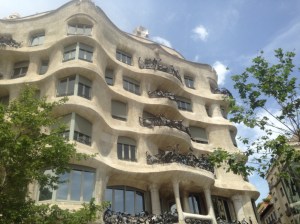
CasaMila


Parc Guell and the Gaudi house:  Parc Guell is the remnants of what was once supposed to be a housing development. Only two of the houses were built (neither designed by Gaudi), and the rest of the area was converted into a park. The walkways run under viaducts, with supports that look like trees, and “the Rosary Path” is bordered by stone balls that every so often (I didn’t count) were replaced by larger stone balls. Not only a Catalan treasure, UNESCO named the park a World Heritage Site.

Gaudi’s home now houses a museum, with artifacts of his life and work — which among other things provide an object lesson about street crossing (Gaudi died three days being struck by a tram) and dressing properly (people assumed that the shabbily dressed Gaudi was a beggar and didn’t give him proper medical care until the chaplain of the Sagrada Familia recognized him, but which time he was already too far gone to be saved). Not to mention caring for all people, regardless of their station in life.

Gaudi’s furniture was displayed in the house. The wooden chairs and benches look comfortable and ergonomic, full of curves and gentle support. I could not help but mentally compare them to the reputedly uncomfortable furniture made by Frank Lloyd Wright for his houses, all straight lines and harsh edges.

Gaudi did not design his house; his assistant did. It seems tame in comparison to the park in which it sits. That makes sense to me: the house was a model house for a real estate development that never materialized. Gaudi had his assistant draw up the plans, they built the house, and then they submitted the plans for approval by the Barcelona City Council. And Gaudi signed the plans, because his assistant was not licensed as an architect.  For some reason, I find all of this amusing.

Casa Batlo. Wow. The roof of this whimsical residence looks like a sleeping sea creature from the outside, the window balconies look like skulls, and the interior staircases seem to be made of the creature’s spine. Oh, and the columns on the front are bones.

The rooms have an entrancing fluidity warmed by wood and light from the enormous windows and the central atrium. The attic spaces are light, made of the catenary arches that Gaudi loved to use. The tiling evokes Monet’s water lilies.

Gaudi did not build Casa Batlo from scratch: the owner gave him an existing apartment building and asked him to redesign it. When an architect so reshapes a building to be unrecognizable from its former self does it matter who put the underlying structure in place?

Casa Batlo makes me happy. I spent the entire tour with a silly grin on my face. Even the stained glass in the transoms reminded me of sea glass. The house is no longer a residence, which is a shame. I would love to live here.
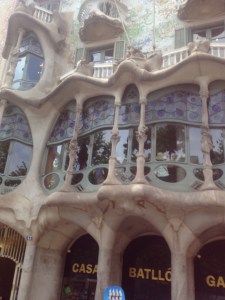
Casa Batlo

Sagrada Familia… Nothing I can write is adequate. All I can do is try.

The Sagrada Familia was one of the two religious structures in the world I have wanted to see (The other is the Hagia Sophia). I had seen pictures, and the basilica looked fascinating.

The “Nativity” facade that you enter by is interesting, and strange, but not life-altering. Arches that would be at home in Carlsbad Caverns protect realistic statues that would not have looked out of place at the Cathedral a few miles across town. The entire Nativity Facade has a melted look, as though it had been made of wax and someone had taken a giant Bunz-o-Matic to it. The Passion Facade on the other side, however, looks markedly different: the stonework is plain, and the statues are abstract almost to the point of Cubism.

The towers are wonderful, too, and not like anything I have seen on any building. From a distance they look like dripped sand. Up close, one can see the almost lattice like structure.

The interior…. Abbot Suger, the father of Gothic architecture, said that light brought you nearer to God.  On the doors to Saint Denis (the first Gothic church) he had inscribed

Bright is the noble work; but, being nobly bright, the work
Should brighten the minds, so that they may travel, through the
true lights,
To the True Light where Christ is the true door.
In what manner it be inherent in this world the golden door defines:
The dull mind rises to truth through that which is material
And, in seeing this light, is resurrected from its former submersion.

The good abbot would have approved of the Sagrada Familia. Light streams in from each side of the nave — red and orange to evoke sunset on one side, and blues and greens on the other, reminiscent of sunrise. The entire church glows.

The gold and red and blue and green meet in the center of the nave: a swirling dance of color. To enter the basilica is to walk into the heart of an opal.

Abstract glass fills traditional forms like rose windows. Unlike a lot of cathedral stained glass, the light streams through the glass without interruption, pure and radiant. No pictures of the Holy Family or the Apostles distract from the glorious incandescence.

IMG_0836 (1)

The pillars resemble trees, branching off to leafy tops. The entire building reflects the nature which so inspired Gaudi in all his works.

With one exception, none of the pictures I took of the interior of the  building came out anything other than blurry. I find this appropriate: the basilica calls to the soul, not to the camera or phone. The people who run it know that too: they have set aside chapels for meditation and prayer. Before I entered one, I was lectured: silence, no cell phones, no pictures. They turned away the young man with the camera ahead of me. (One of my pet peeves with tourists in historic churches is when they take pictures of people in prayer. They eavesdrop on a conversation between someone and God, and whatever the tourist’s beliefs they have no right to do so.)

I sat in the chapel, and I began to cry. I don’t know why.

Gaudi knew that the Sagrada Familia would not be finished in his lifetime. He once commented “My client is not in a hurry.” At the time of his death, the church was only fifteen to twenty – five per cent  completed. Gaudi left blueprints and instructions, many of which were destroyed in the Spanish Civil War. (Some of those plans have since been reconstructed.) Since his death, work has been carried on by others, who have, like Gaudi, drawn their inspiration from the forms of nature. The doors on the nativity facade, covered with leaves, were created by a Japanese designer. The church is a living thing: architects and craftsmen have been working on it since Gaudi’s death, and people who visited ten years ago saw a different but still wonderful building. It is expected to be finished in 2026, the centenary of Gaudi’s passing.

Putting so much of your life (Gaudi moved into the Sagrada Familia’s workshops a few years before he died)  into a church you know you will not see completed speaks of a deep and abiding faith. By all accounts, Gaudi was a devout Catholic, not the “goes to church every Sunday” devout, but with a true love of God. The church calls people to faith, speaks of the Eternal and the Almighty.

There are efforts to have Gaudi beatified (the step below sainthood).  I’d say he deserved it.


Posted in Culture (popular and otherwise), Travel (real or imaginary) | Tagged , | 5 Comments

Hi there! Miss me?

Note to self: never even think, let alone say out loud, anything along the lines of “I have seen the Sagrada Familia, I have walked inside an opal, I can die happy now.” Because Fate will look down her nose at you and reply “Reeeeaaaallly. Hold my beer,” and you will find yourself on a Saturday evening in the urgencias department of a Madrid city hospital, having a very young (she looked about twelve, I swear) intern explain to you that you have “pneumonia in, how is it? both lobes of your lungs.” (As it turned out she was wrong, although I wouldn’t find that out for a couple of days: due to a miscommunication between me and the x-ray tech, which is not surprising since we did not speak each other’s language, I had not breathed in fully, so the x-ray  was ambiguous. I did, however, definitely have pneumonia in my left lobe.)

I have a post about Gaudi that is nearly done.

I have a post I want to write about being in the hospital.

I had no computer in the hospital, so I have not been online for five days, so I don’t know what’s been happening in the world (although, actually, that was kind of nice), so I don’t know if there is anything else I want to write about.

But right now I am exhausted just by the effort of sitting up for long periods of time or walking a block. (Yes, the doctor cleared me to fly.) So I don’t know how long those will take.


Posted in Travel (real or imaginary) | Tagged | Leave a comment

Barcelona

Traveling in Europe has challenges for someone like me who has an impossibly hard time with languages other than English. And in Barcelona, I not only don’t know one language, I don’t know two. When I was growing up, I was told that there were five Romance languages: French, Italian, Romanian, Portuguese, and Spanish. If I was taught anything about Catalan, it was a dialect of Spanish. Wrong: Catalan is its own language, much like Dutch is different from German.

Barcelona may now rival my beloved Madrid as my favorite city in Europe. In no small part this is due to Antoni Gaudi. I was going to write about him here, but decided he deserved his own post.

Gaudi aside, lovely architecture abounds. There is the Catalan Music Hall, and the Cathedral, and the row of Art Nouveau houses on the “Street of Discord.” We only saw the last  in passing, as we  spent so much time at Gaudi’s Casa Batlo. Not to mention the Cathedral. Oh, and the unidentified building — appears to be late 17th or early 18th century — that has been covered with googly eyes. No, really. (Unfortunately my picture of the googly-eyes house didn’t come out well enough to show its full  bizarre glory.) And, much like Paris, some of the Metro entrances feature Art Nouveau wrought iron.

IMG_0787

The music hall.

Day Three: In the morning I started off with a coffee con leche and a croissant at the cafe that was literally at the base of the apartment building we were staying in. (I have yet to find the European country where the coffee is not better than in the U. S.) I then walked around the Gothic Quarter. On my way, I saw a building that reminded me of one of the reasons I love Europe. Buildings that in America would be tourist attractions, in Barcelona are ….. bank offices. (Once, in Segovia, I saw “Charles was here, 1785” scratched into the stone of an aqueduct that dated to the time of the Romans, thus proving that people have always been people.)

IMG_0795

Just your ordinary bank building.

At the cathedral square, I encountered a “living statue” — in this case what appeared to be a bronze statue of Galileo. I watched him for a while, and he was absolutely still, except when a young man took picture after picture and then left without tipping. At that point a very brief expression of annoyance flashed across the ersatz Galileo’s face. Whereas I, who took no pictures but nonetheless gave the man a Euro, was rewarded by a slow, jerky change of position, a smile, and a bow.

I tip street performers when they are good. The street performers in Barcelona’s Gothic Quarter are very good.

As I meandered, I happened upon Barcelona’s City Hall, and a subtle indication of what the Spanish think of our president:

IMG_0796

Hear that, Donald?

I also came across the State Archives for the Crown of Aragon. Outside the building they posted a picture of the contract Isabella signed with Columbus. It was a pretty good deative.)l for Columbus: he got one tenth of all the booty, after expenses, and for all subsequent expeditions was to foot one eight of the costs of building the ships in exchange for one eighth of the profits. Had his voyages been as successful as other explorers, he might have been a wealthy man.

And then there was this piece of public art, which seemed incongruous in the Gothic Quarter, thus proving that no country has a monopoly on WTF sculptures:

IMG_0804

For those times when your radioactive monster chickens need to be restrained.

I was only there for a couple of days, so there was so much I did not do. I did not go to all of Gaudi’s building. I did not go swimming or snorkeling. I did not go down the Ramblas, the main tourist thoroughfare. And I could spend hours just going around the city in a cab. (Cabs are pretty reasonably priced here. If you have multiple people it’s pretty cost-effective.)

Barcelona. I may be in love.


Posted in Art, Travel (real or imaginary) | Tagged | Leave a comment

Transit to Spain.

Once upon a time, a woman called Super Shuttle for a ride to the airport. For her 7:30 flight, they picked her up at 3:45. AM. It might not have been so bad, except Penwiper, distraught that yet another of her humans was leaving her (she had seen the suitcases in the hall), spent the entire night hitting said human in the face or, once shut out of the room, sitting and yowling loudly outside the door. So much for sleep.

I got the the airport three hours before the flight, and spent the time in the United Lounge. I deeply appreciate not having to hang out at the gate. I appreciated it even more when I had no access to a lounge in Montreal and …. spent three hours hanging out at the  gate.

Air Canada people are, like most Canadians, nice. Really nice. I would fly with them any time. (Unlike, say, another international airline who shall go unnamed but whose initials are “AF” and who are based at Charles de Gaulle International Airport.)

Montreal airport was nothing special, especially given that I spent three hours at the gate. Next to the gate was a toy store. I kept saying “I’m too old for stuffed animals….I’m too old for stuffed animals…. I’m too old for….

IMG_0790


Damn.

I don’t have a name for the owl, other than Pride Owl. He (of course he’s a he) needs a better name.

The flight from Montreal was not bad — I had two seats to myself. I couldn’t sleep (I never sleep on airplanes), but I had noise-reducing headphones, a full phone battery, and soothing music on my iPhone. The trip went faster than I expected.

I often use mobility assistance in airports. Due to fibromyalgia, walking the distances required is a slow process,, especially given the luggage involved. I try to check most everything, but that still leaves me with a small carry on, a backpack, and medical equipment. (Twenty minute walks to the gate become 40 minute walks for me when my fibro kicks in.) If I have a luggage cart to lean on, the walks are less of a problem, but you don’t see luggage carts once you get through security.) One of the advantages is the ability to get through lines quickly.

When I got to Barcelona, there was no mobility assistance. No problem, I thought. I would just take a long time, but I could do this, as long as I didn’t have to stand too long. I hobbled the short walk to passport control. As I rounded the corner, I said to myself, “That’s not too bad.” Then I got closer, and saw the line snaked around another corner. “Hmmm.” I walked abound that corner so I could get to the line’s end and “Holy crap.” The line doubled back and forth several times. It was Space Mountain the week between Christmas and New Year’s. The only thing missing was a “You must be this tall to use this passport kiosk” sign.

So I stood and I stood and I stood some more. Quite unpleasant — painful, even — but I was in the same boat as everyone else. It was worth it to see Barcelona.

[To be continued.]


Posted in Travel (real or imaginary) | Leave a comment

Stigma.

In my Facebook feed today, a friend innocently used the word “bipolar” to refer to God — specifically the erratic, capricious, and vengeful God worshipped by fundamentalist Christians. She meant no harm, and when I spoke up, she immediately recognized what she had said, and apologized. I was not offended so much as saddened.

I was saddened because I know that almost all the people reading would know what she was aiming at. I was saddened because that’s what “bipolar” means in this society: fickle, changeable, unpredictable, acting out, swinging wildly from one personality to another. More than once I have seen people write “I’ve been so bipolar this week,” when they mean that their life has been all over the place.

The same with “schizophrenic.” People use it as a casual insult about others they view as unreliable and untrustworthy.

These words, these uses, have been internalized by all of us, myself included. But “bipolar” and “schizophrenic” are medical terms. How do you think the casual usage  affects how we view people with those disorders? Among other things, people think they know what a particular diagnosis entails, when they could not be more wrong.

Being bipolar does not in and of itself mean being impulsive and changeable, even if those attributes might be a symptom of the disorder for some people.

Schizophrenic does not mean acting like two people.

Depression — clinical depression — is not merely sadness.

Bipolar disorder is slowly being understood more and more by the public, in large part because of celebrities who speak out their own disability. (God bless you and keep you, Carrie Fisher. I would say the same thing to you Stephen Fry, except I understand that you’re an atheist. So I’ll just say thank you.)

Schizophrenia, though…. People fear schizophrenics: “paranoid schizophrenia” seems to be the diagnosis of choice of fictional detectives dealing with serial killers. But there are law school professors with schizophrenia (just as there are medical school professors with bipolar disorder). The condition does not have to be debilitating if managed. Efforts to combat stigma are even more important with schizophrenia than with bipolar disorder and depression.

Having a mental illness makes it harder to find employment, even though employment helps keep us functional. Telling employers of your disability is often a kiss of death for  job prospects until after you have been hired, when you tell them you may need accommodations. Thank God for the Americans with Disabilities Act. (Although I am outspoken about my disability here, or in non-employment contexts, I usually do not tell a potential or actual employer (or coworker) about my bipolar disorder until necessary.* I’m not alone: a few years ago I told a coworker (and friend) I had bipolar disorder. There was a silence, followed by “So do I.” I had been working with this man for two years at that point.)

These are serious illnesses. The more we stigmatize them the more likely it is that people who need help will refuse to get it. And bipolar disorder and major depression are often terminal if left untreated.

I have been told by some of my friends and all of my medical professionals that I am “brave” for being outspoken about my bipolar order. Wrong. All I am doing is trying to put a human face on something that all too often is hidden, except to show up when some person with bipolar disorder or schizophrenia commits an act of violence, either in real life or on Criminal Minds. (Far more violence is committed by people who are not mentally ill. And as I have often pointed out before, people who are mentally ill are more likely to be victims of violence than perpetrators.) My role models are that generation of lesbians and gay men who spoke out — who are still speaking out — to insist on being recognized as fully human and having the same rights as everyone else.

I’m not brave. I’m just fed up.

*If they Google me, and find this blog, they’ll know, but that’s a risk I am more than willing to take. If they don’t want to hire me because of what I write here, I might not feel comfortable working for them anyway.

Posted in My life and times | Tagged | Leave a comment

Three suggestions.

  1. Can we tone down the “impeachment!” talk? While I think that is where this will end up eventually, a) it is a long way down the road (it’s not like Trump will go gently into that good night), and b) it makes us look like we are more interested in revenge than justice. Let’s face it, even if we successfully impeach the bastard in a year or two, this is a tragedy for our country, and will lead to further division.
  2. Can we stop ruminating on whether or not it would be for the best if we just let Trump ride out his term? I know Mike Pence is not ideal. I know that in some ways he represents a threat to the country. Trump, however, represents a threat to the entire world.
  3. And something I have wanted to say for a year and a half: can we FINALLY stop talking about Trump’s appearance? Who gives a damn if he’s orange? He’s a fucking psychopath! If it’s not okay to make fun of Hillary’s clothing choices, it shouldn’t be okay to mock Trump’s complexion.

After all, it’s not like there aren’t a lot of other things — substantive things — about him for us to mock.

Posted in Politics | Leave a comment

Catharsis.

The kids are all, for the most part, gone.

One is home, but working.

One is at school.

One, God help me, teaches English… in Seoul, South Korea. [Yet another reason the Trump presidency has been bad for my blood pressure.]

I am currently taking classes. I am having to adapt to spending lots of time alone in the house. It’s been really unsettling.  But today,  I found a consolation for all that… quiet: it’s possible to scream at the top of my lungs. If you were in the house this afternoon, you would have heard…

“EVERYONE GIVE UP FOR AMERICA’S FAVORITE FIGHTING FRENCHMAN!!!!!”

“LAFAYETTE!!!!!!”… “LAFAYETTE!!!”… “LAFAYETTE!!!”… “LAFAYETTE!!”… “LAFAYETTE!!” and then “HAMILTON!!!…HAMILTON!!!”…”HAMILTON!!!”…..

Obsession. It’s a good thing

Now, to get back to this week’s major project.

Posted in Culture (popular and otherwise) | Tagged , | Leave a comment

Compassion.

I weep for you,’ the Walrus said:
      I deeply sympathize.’
With sobs and tears he sorted out
      Those of the largest size,
Holding his pocket-handkerchief
      Before his streaming eyes.
Lewis Carroll, “The Walrus and the Carpenter.”


Sometimes enlightenment comes from the strangest places.

As can be expected I have been following the ACHA debacle closely.  I have been frustrated by the seeming callousness of some of the supporters of the new bill. Some of them seem dangerously clueless, such as the representative who claimed that people who didn’t need health care led better lives. Some have simply flat out lied to their constituents about how the bill will effect them.

Then there is Representative Joe Walsh. In response to Jimmy Kimmel’s touching recounting of his infant son’s life-threatening heart problems, which if you haven’t seen you should, the good Representative tweeted “Sorry Jimmy Kimmel: your sad story doesn’t obligate me or anybody else to pay for somebody else’s health care.”*

I struggle to articulate the thinking behind a statement like this. Yes, it’s selfishness, but it is also something else. That’s where the Barenaked Ladies came in.

As I sat trying to figure what to blog about this, the BNL song “Bank Job” popped up on my iTunes. In the last verse, the narrator of the story in the song expresses the outlook of many of the people I read about who support Trumpcare, even knowing that it will result in millions losing healthcare:

“I’m all for compassion, just not on my dime.”

You see that a lot.

I have compassion for people who lack insurance,  just don’t raise my taxes — no matter how small the amount of the increase — to help them get it.

We really need to help schools in poor neighborhoods, but I refuse to vote for a parcel tax because my kids don’t go to school anymore.

The poor Syrian refugees face untold horrors, but we need to prevent any of them from coming into the country.

I feel sorry for women who have been raped, but we can’t allow them to have access to Plan B or any form of abortion.

The Native Americans are understandably upset about their water and land being threatened, but we need to build the Dakota Access Pipeline, because it will bring jobs.

It’s tragic that young men die at the hands of the police, but we can’t criticize our men in blue, let alone hold them accountable.

It’s a shame about families being torn apart, but we do need to deport every illegal in the country, including the ones brought here as children who have not known any other country than the US.

So many people claim to be compassionate, but it’s compassion that isn’t on “their dime.” This isn’t compassion. It’s ersatz compassion, seeking validation for being a good person without having to commit to anything. It’s the compassion of the Walrus for the oysters, claiming a moral high ground while consuming those they claim to care for. Pro-tip: anytime someone uses the words “I have compassion for…,” they generally don’t.

Real compassion is muscular; real compassion calls for action.  The truly compassionate say not “I have compassion, but…” but instead “I have compassion, and….”

For a long time, I used to state I had compassion for people who held horrible views. After all, racists or misogynists must have bitterness in their hearts that made their lies miserable, right? Yes, the objects of their hatred are the first priority, but shouldn’t we feel sorry for people who constricted their world in such a way?

I don’t feel that way anymore. For one thing, it’s condescending as hell. For another, this forces me to pretend that I didn’t feel anger or disgust (or even, yes, hatred: I don’t claim to be a good person). Most importantly, it moves the focus of discussion away from where it really should be: on the victims of racism or misogyny.

It’s much better not to pretend to be compassionate. I don’t have compassion for the extreme alt-left (the preferred term these days, rather than Bernie bot), I have fury towards them. I don’t have compassion for Trump voters, I despise some (not all) of them for what they have done to my country. It would be hypocritical for me to claim otherwise.

Honesty is much better than compassion. That way,  you don’t try to influence people to care for others that neither warrant nor, in many cases, want your concern.

*Considering that Joe Walsh (no relation, I’m sure to the absolutely fabulous guitarist for the Eagles) once was taken to court for not paying child support, I don’t think he’s in any position to chide someone else like this. Neither does the Twitterverse — he got absolutely slammed. Not to mention that Walsh here demonstrates a total lack of understanding about how insurance works: every one who has insurance pays into a pot of money, which is then doled out to pay for health care. In a sense, every time someone uses their health insurance, someone else is (at least partially) paying for their health care. It’s appalling how many people just don’t get this.

Posted in Politics | Tagged | Leave a comment

Today’s disgruntled political thought.

I am SO tired of election postmortems, from both sides. It’s arguing over who attacked the old man while he is lying on the sidewalk bleeding out.

There’s a time and a place, right? And this is not the time to be fighting over who did what six months ago when we’re desperately struggling for our political our democratic  lives.

Posted in Politics | Leave a comment

Notes to self:

  1. Just as you have been contemplating a timer to reduce your Facebook usage, you should use a timer to control your news viewing, even though it’s not every day that the FBI director gets canned..
  2. Speaking of Facebook, don’t make snarky and rude comments about friends of friends. Not that you care what the friend of the friend thinks, but you do really care what your friend thinks.
  3. When using a new cleanser, use it only on your face, rather than also on your eyelids, even though it is ostensibly safe for such. That way, when the hives show up, it will only be your face that itches like crazy, not also your eyes.
  4. Don’t use two new products at the same time: you never know which one it was. I really liked both of them, too. I guess I’ll have to wait to find the special product that will make me look like I was thirty-five again.
  5. Having to have someone drive you to school because you are doped up on Benadryl is a pain for everyone involved. Especially since you can’t miss class because you are going to miss two classes when you go to Spain, and you’ve already missed one when you saw Hamilton. Not that I would have missed Hamilton for the world (not even for Spain). You are already having to beg the teacher for one absence over the two allowed. Fortunately, you have a sterling attendance and homework record.
  6. God, class is going to seem long tonight. I just hope I can remain coherent.
  7. Why aren’t you writing more?
Posted in My life and times | Tagged | Leave a comment

Thanking teachers.

I had a less than stellar childhood. When I look back, I had a lot of unhappiness. School should have been a bright spot, and in some ways it was, but in other ways it was horrible. Some people — teachers — made all the difference.

The earliest teacher of which I have a memory is Mrs. North in fourth grade. In music class, she taught us show tunes: Oliver!, The Sound of Music, and (although it was probably inappropriate for a public school), Godspell. Along with my father, she made show tunes cool, and she is one of the reasons that I have at least one song from probably  a hundred different shows*, not including revivals and movie soundtracks, on my iTunes. I have complete soundtracks from about thirty shows — I purged a bunch about a year ago; before then I had about sixty full soundtracks. (As I said, not including revivals — I have three different versions of Sondheim’s Follies.)

If memory serves, Mrs. North was also the teacher that told my Mom I was failing English because I wasn’t doing the book reports. Given that I read constantly**, and well above grade level, but simply was too lazy to write about what I read, Mom was understandably outraged. (At me, not Mrs. North. In all my years of school, my parents never interceded with a teacher on my behalf, partially because they didn’t need to, but also because they believed that if I was getting a bad grade it was my responsibility to work harder.)

I had Mr. Lindsey in the seventh grade. Mr Lindsey made me feel like I was worth something: that it didn’t matter if I was popular or pretty as long as I was smart. He also had Jeopardy! type games every week covering what we were supposed to have learned. Those games marked the first — and only — time I have been picked first, that people argued over who got to have me on their team. The team I was on always won.

Mr. Lindsey was also the first person to call me Pat rather than Patty, which nickname I adopted with alacrity. (I had never really liked Patty, let alone Patsy.) Pat made me feel stronger, more capable. He also allowed students to  challenge what he said, up to a point, provided that they could back up what they said with a reputable source. Once, he was talking about Mt. Everest being the tallest mountain on earth. I raised my hand. “It’s not,” I said. “Mauna Kea in Hawaii is.” We went back and forth about it a bit, and when I brought in the book on earth sciences I was reading that stated that Mauna Kea, when measured from its base on the ocean floor, was taller than Everest, he admitted I was right. Mr. Lindsey then said “Mt. Everest is the highest point on earth,” and looked at me challengingly. “I never said it wasn’t,” I replied, looking angelic. It’s a bit of a miracle he didn’t thwap me.

Mrs. French was my sometimes cranky English teacher. She taught me a love of poetry, of memorizing poetry, of the sound of the rhythm of the words. She’s the reason that — until my memory got hazy — I could recite all of Langston Hughes’ “Harlem” and pretty much all of Lewis Carroll’s “The Walrus and the Carpenter.” I learned to seek out poetry on my own, from the frantic rush of e.e. cummings “next to god of course america” to the enveloping hidden sadness of Eliot’s “The Love Song of J. Alfred Prufrock.”

Then high school. High school was, like it was for many of us, miserable. But there were teachers who helped there, too.

Mr. Oescher was my ideal of a math teacher: he believed in teaching not only the formulas, and how they worked, but also why they worked. A lot of students hated being in his class: he required you to think, not just memorize. I loved having him; I only wish I could have had him for both halves of Trigonometry, even though I got a better grade in Mr. Jacob’s class.

Ms. Kostbar taught Chemistry. I loved Chemistry, and I loved the way she taught it. I was disappointed when the powers that be decreed that they were getting rid of Chem 2 and that we needed to do the class as independent study. (We had to arrange lab time, and do the other work on our own. What can I say? Florida schools at that time were some of the worst in the country.) She also believed in my ability: as a result of some abysmal grades freshman year, I didn’t make Honor Society until my Senior year. Mrs. Kostbar (who was the faculty advisor), was not happy with me: “You should have made it last year. You are smart enough.”

And then there is Mrs. Cogar. I have written about her before; she changed my life, far more than any teacher I have ever had, either before or since. From her I learned to be analytical, but that it was also possible to overanalyze. She introduced me to Frost, and Steinbeck, and O’Neill. If I could only thank one teacher, it would be her. (She would be slightly appalled at my writing these days, though: I use the passive tense far too much.)

There were teachers in college (Alice Robinson, Nina Tumarkin**) and law school (Buzz Thompson, Barbara Babcock) whose classes I enjoyed, were challenged by, and where I learned to think critically.

But my teachers in middle and high school helped change me and shape me into who I am now. They told me it was okay to always ask “Why?” and that facts mattered, and that intelligence was not something to be ashamed of. They taught me to look for the answers other than the obvious, and that challenging authority was good, sometimes.

I thank them with all my heart.

*Full disclosure: a lot of those are on the six-disc set for Broadway: The American Musical, which I got for Christmas about seven or eight years ago. I was delighted; my family not so much.
**Some kids had parents who took away television privileges as punishment. Mine shut away my books (usually to get me to clean my room).
***Even though I got As and A-s in a lot of classes, the grade I am most proud of in all my years at Wellesley is the B+  in Nina Tumarkin’s 20th Century History Class. The final consisted of two questions, one of which was along the lines of “What changes would you make to the Treaty of Versailles so as to alleviate the conditions which led to the rise of Nazi Germany?” Or, more simply, “Rewrite the Treaty of Versailles so it works.”)

Posted in My life and times | 1 Comment