A couple of my lists…

Most annoying major characters in fiction:

Holden Caulfield, Catcher in the Rye
Cathy & Heathcliff, Wuthering Heights
Marianne Dashwood, Sense and Sensibility
Romeo & Juliet, Romeo & Juliet
Valentine Michael Smith, Stranger in a Strange Land
Chance the Gardener, Being There
Daisy Buchanan, The Great Gatsby
Harry Potter, Harry Potter & the Order of the Phoenix*

Most annoying major characters from the Big Screen**:

Scarlett O’Hara, Gone with the Wind
Luke Skywalker, Star Wars***
Anakin Skywalker & Padme, Star Wars: Revenge of the Sith
Jay, Dogma
Ariel, The Little Mermaid
Marlin, Finding Nemo
Shelby Latcherie, Steel Magnolias
Frodo Baggins and Sam Gamgee, The Lord of the Ring: Return of the King

What are yours?


*I know this is an outlier on several fronts but I wanted to include it.  I love the HP books, and for most of the series I like Harry.  But during most of the fifth book I kept thinking the protagonist needed to be slapped into next week.  I also think Snape had some good points about the less exalted parts of Harry’s character — for example, there is no record of Harry ever being grateful to Snape even after he learned that Snape had saved his life during the Quidditch match in The Sorcerer’s Stone, is there?

**Note: being on this list does not mean that I dislike the movie.  I own four of the movies on that list: Dogma, Finding Nemo, Master & Commander: The Far Side of the World, The Lord of the Rings: Return of the King.  Movies with annoying characters can in be redeemed if they write the character well (Finding Nemo), or the other strengths of the  movie outweigh having a character that drives me batty (Star Wars).  As much as I dislike the character of Jay, for example, Dogma is one my favorite movies simply because a) it raises some interesting questions about the nature of faith and b) even more so, Alan Rickman’s sardonic turn as the voice of God.  


***I refuse to refer to this movie as A New Hope. Not gonna happen. 

Posted in Culture (popular and otherwise) | 4 Comments

"Sensibility" and me.

I love Pride and Prejudice.  It is one of my favorite books, and I reread it often.  I do not have the same depth of emotion about Sense and Sensibility, however:  in fact until two days ago I had never been able to finish it.  I could not put my finger on what I found so off-putting about this novel, until I realized that it was Marianne Dashwood.

Marianne Dashwood, one of the two sisters at the heart of the story (to whom the “sensibility” of the title refers) makes my list of the top ten most annoying characters in literature.  She’s not Holden Caulfield from Catcher in the Rye, nor Heathcliff and Cathy from Wuthering Heights, but she is extremely irritating.

She is self-indulgent.  She is over-emotional.  She gives free reign to her fancies.  She is impulsive.  She is given to letting her emotions run ahead of reason.  She is imprudent.   She wears her heart on her sleeve.  She is a drama queen, par excellence.

Sort of like me, actually.

Not completely, of course — I’m nowhere near as extravagant in my demonstrativeness*, for one thing — but there is enough of the underlying emotional tendencies to make me uncomfortable.  Sometimes the things you most dislike in other people are the aspects of your own character that are the most problematic.

I wish my temperament were more like Elinor Dashwood’s: strong, level-headed, restrained.  She deals with heartbreak with fortitude and strength.  She calmly assesses situations, and is a comfort to others in the midst of her own disappointment.  She is resilient.

There is a chance for change: by the end of the book Marianne has come to the realization that her emotional tendencies are bad for her, and is determined to be more reasoned in her approach to life.  It works out well — instead of marrying the scoundrel Willoughby, she ends up with the devoted, honorable Alan Rickman Colonel Brandon.**

There’s hope.

*I sincerely hope. I do try not to be a drama queen.
**When reading this book, I had to let go of my feeling that a thirty-six year old man being in love with a young woman of seventeen was very creepy.  Different mores in Austen’s day, and all that.

Posted in Books, Who I am | Leave a comment

Over at Lawyers, Guns and Money, Scott Lemiuex (“There are Many Life and Death Issues”, “All American Presidential Elections are Choices Between Evils”), Paul Campos (“Purity of Essence”), Erik Loomis (“Nobody is Sweeping Dead Muslims Under the Rug”), and djw (“Dealbreakers”) explore the morality of voting for third party candidates  in an election such as that facing us, and why Obama’s failures as a bellwether progressive should not prompt people to do so.

And Erik Loomis has a thoughtful piece on one possible reason why progressives have failed to create an effective mass movement in the past several decades, “Cultural Origins of Green Lanterism.” I like it so much, I am inclined to forgive him for having voted for Nader in 2000.  Everybody was young and stupid once.

All well worth reading.

Posted in Politics | Tagged | Leave a comment

But Pachelbel’s Canon gets so booooring…

I was sitting at lunch today with a group of people when my phone went off.  My ringtone set off howls of laughter.

The melodious interlude that so amused my cohorts was… “The Super Chicken Theme Song.
I used to have Pachelbel’s “Canon,” and before that, “Eine Kleine Nachtmusik,” as my ringtone, but once I heard the Super Chicken Theme Song, I knew I had found the one ringtone that truly represented who I am.  More or less.  As an added incentive, all three of my children believe it to be the most annoying ringtone they have ever heard.
I just need to remember to switch it to something more professional before I go into job interviews.

Cluck cluck cluck cluck.

Posted in My life and times | Leave a comment

That’s what I get for signing him up for that philosophy class at the community college last summer.

According to The Red-Headed Menace, “hipsterism is the bastard child of transcendentalism and existentialism.”*

*He made sort of a cogent argument for this position, but I was too bemused by the fact that he was trying to determine the philosophical antecedents of hipsterism in the first place to listen closely.

Posted in Kids in all their glory | Tagged | 1 Comment

On hearing a segment on NPR about child-raising, and a child who kept asking “why?”, The Red-Headed Menace casually stated “that was me for about four years.”
“Oh, no,” I replied.  “That has been you for 16 years.”
“No — it was me for 14 years.  Then I discovered Wikipedia.”
Posted in Things my kids say | Tagged | 1 Comment

Bits of Italy.

I just returned from ten days in Italy.  Ten days was far too short: my stay there had to be fitted around someone else’s work obligations and as a result there was too little time to spend on a country so wonderful and diverse.

It strikes me that more than France, Italy has a sense of having been other countries once.  Perhaps it is because reunification was so recent, relatively speaking, and so celebrated, it has cities which all feel different from each other.  All proud of their varied histories.

Venice, so decadent, so magical, so much like stepping back into another era.*  Florence, upbeat and a little frenetic, colorful and inspiring.  Looking at Brunelleschi’s dome, for example, or the Palazzo Vecchio, with its white marble statuary in front of its red brick, it’s easy to remember that the Renaissance started here.  Rome, grand, yet so matter of fact.  What would have been a major archaeological site in France would be simply another ruin there.  History seeps into the present in all of these places, connecting me to the great mass of human beings who have gone before.

And that doesn’t count the other places: Turin, which I have written of fondly, and Verona, where we stopped to view the best preserved Roman amphitheater in the world — it is still used as a performance venue;  the day before we visited, there was a production of Aida.  (We did not visit “Juliet’s House.”  While I find it charming that Verona embraces its Shakespearean heritage, I have no desire to see the alleged residence of a fictional character.)

We spent a night in Volterra, a town in the Tuscan hill country.  Volterra sits on not just Roman ruins but on those of the Estruscans, an even older civilization. By chance we happened to  stay in Volterra on the night of an annual local festival, when all the restaurants and stores were open until midnight and the museums were free.  Looking at Etruscan funerary urns with their representations of the dead made me feel both connected to the past and melancholy from the mementos of mortality. But I then went and listened to musicians playing in the town square, surrounded by an admiring group of locals, which reminded me how good life can be.

Driving through Tuscany on a clear, cool late summer morning was a gift.  So was driving across the border to Switzerland to Lugano for dinner.

And the art, the art, the art.

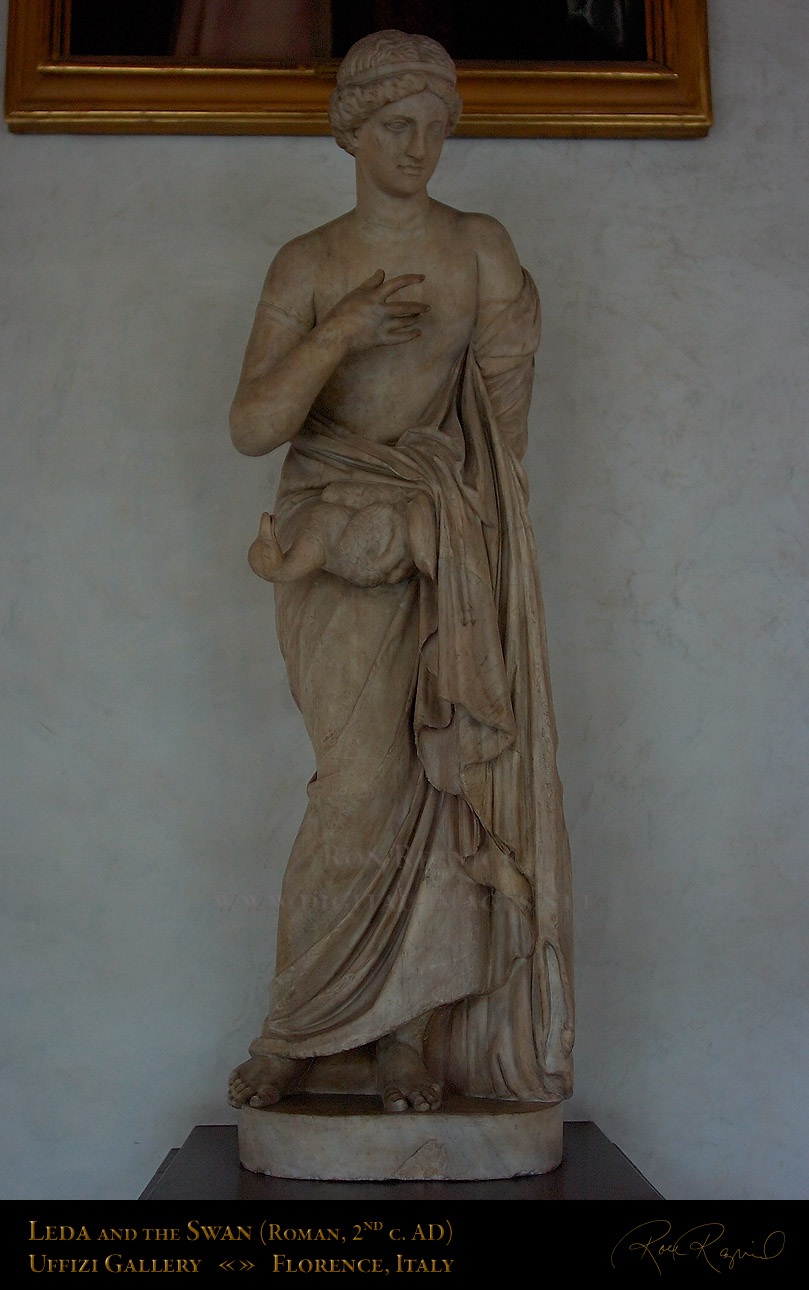
I saw the Uffizi, with the Botticellis, and Titian’s Venus of Urbino, and my favorite classical statue of all time — a suggestive Leda.**  I saw the Vatican Museum, with more wonderful classical sculpture, and the Sistine Chapel, but best of all, Raphael’s School of Athens.

I saw Michaelangelo’s Pieta.  I saw the David.

(I expected Botticelli’s Birth of Venus to be more monumental in person than it was.  I liked it, but it did not blow me away.  Michaelangelo’s David, on the other hand… my first glimpse made me gasp.***)

Going to Italy led me to mentally revisit the architectural history course I took a quarter of a century ago: The Doge’s Palace (with its intricate map room) and Piazza San Marco in Venice, Brunelleschi’s Dome and Ghiberti’s Baptistry doors in Florence. St. Peter’s, which is the most amazing church — building, actually — I’ve ever been in, and The Pantheon in Rome, with the holes where the bronze friezes on the front were stripped to make the baldacchin over the high altar at St. Peter’s.

And the little delights: that the Rio de la Plata on Bernini’s Four Rivers fountain in Rome has a prickly pear cactus represented on it surprises me, even though I know that Europeans had already been to the New World at the time of the fountain’s unveiling in 1651.  That the pages of Leonardo da Vinci’s notebooks, which we saw the first night in Milan, were so random, and yet somehow cohesive at the same time.

My traveling companion and I complemented each other.  He was interested in engineering, in origins — he wanted to see Roman and Etruscan sights.  I, on the other hand, hungered for the Florence, Venice, and Rome of the Renaissance and the Baroque. He tagged along to the Uffizi and St. Peter’s, I followed him to the Colosseum and the Forum.

Yes, we did touristy things.  Like everyone else, we threw coins into the Trevi Fountain, after fighting our way down to the edge.  We climbed the Spanish Steps. Visiting the Vatican required patience and resistance to the crush of people, many of them in tour groups, surging towards the Sistine Chapel. (The Vatican may be the worst museum for tour groups I have ever seen.  Except for the parts deliberately designed as museums by various popes, the rooms are narrow, with no spaces for guides to step aside and talk.)  I began to get annoyed at my fellow travelers, and not merely because there were so many of them: can’t you understand that using flash while taking pictures damages the art? Can’t you understand that the Sistine Chapel is, in theory at least, a place of worship and to be treated respectfully? (The guards, who frequently shouted “Silence!” in four different languages in a fruitless attempt to maintain an atmosphere suitable for contemplation, had my complete sympathies.) Can’t you understand that taking pictures of people at prayer in St. Peter’s — or any other church — is intrusive and rude?

There were the things that were the same as home, only different: in Venice, when the water-taxi took us to our hotel, we passed a sign telling passing boaters how fast they were going and that they needed to slow down. We passed one gondolier who was checking his iPhone as he poled a couple under the Ponte di Rialto.  In Florence, the expressions on the faces of the people on the bus were like the faces of people on the bus at home, except we were rattling through narrow streets filled with picturesque apartments.  And toddlers — toddlers are the same everywhere.

I was struck by the number of women in Muslim garb, especially in Milan.  Not merely headscarves, which I see at home, but in full length dress or even in burqas with only eyes showing.  It is worth noting that in St. Mark’s Cathedral in Venice, burqas are not allowed: the dress code prohibits any clothing which obscures the face.  (The other parts of the dress code are concerned with showing respect: no skirts above the knee, no shorts (on men or women), covered shoulders. You could buy a triangular shawl for your shoulders if you were otherwise not modest enough. The Vatican had a similar dress code.  I have no problem with this at all: it seems to me that if you are going to traipse around a church you should dress appropriately, not like you were going to go play Frisbee.)

For the most part, the people were lovely, and those who did not speak English were tolerant of my broken efforts to communicate.  The cabbie who refused to drop us off at our hotel, leaving us to walk two blocks uphill while other taxis passed us, was  more than made up for by the taxi driver the next night, who returned to our hotel after he dropped us off to leave a five euro note, since he discovered he had given us the wrong change.

The food was wonderful.  The best fish I have eaten in years in Venice, amazing veal saltimbocca in Volterra, lovely risotto in Milan, sublime gnocchi in saffron sauce in Lugano, great pasta everywhere.

I need to go back.  I need to revisit the David.  I need to see the Borghese collection in Rome and take the elevator to the top of St. Peter’s.  I need to sit again on the Piazza San Marco and watch couples dancing in the moonlight.  I need to go to Pisa, which wasn’t on the itinerary at all.

Amo l’Italia.

*And so confusing:  Venice gives new meaning to the phrase “You can’t get there from here.”
**Leda, for those who don’t know the story, was supposedly seduced by a swan that was Jupiter in disguise.  The Uffizi’s Leda is a statue of a woman tenderly cradling a bird — the size of a duck, not a swan — while slipping its tail in into her robes with a lascivious expression .  I found the statue startling, which is always a good thing in art, and it made me laugh.
***I am vaguely ashamed that it bothers me that David is uncircumcised.  In fact, I am vaguely ashamed I even noticed that David is uncircumcised.

Posted in My life and times, Travel (real or imaginary) | 1 Comment

Closing in.

Many people have “bucket lists” with numerous items on them.  Go skydiving, visit every state in the Union, run with the bulls at Pamplona, that sort of thing.

I have one item on my list.  One, that’s it.

I want to see the top ten art museums in the world.*

The Louvre and The Orsay. The Met in New York, the Art Institute of Chicago, the National Gallery in D.C., and the Getty in L.A. And now, the Uffizi in Florence and the Vatican.

Nine down; one, The Tate Modern in London, to go.**

*I am using a list from Reuters. Other lists I have seen include The Hermitage in St. Petersburg and the Rijksmuseum in Amsterdam, both of which I have seen. 
**Of course, they are opening new museums all the time, as well as older museums upgrading their collections.  I would love to see the Guggenheims — in New York, which I have yet to catch, or in Bilboa — and the Art History Museum in Vienna, for example.

Posted in Art, Culture (popular and otherwise) | Tagged , | Leave a comment

A tale of a city.

Venice is magic.  It is seductive, charming, decadent, fun.

The Piazza San Marcos glows in the late afternoon sunlight, relatively sparsely populated now that the basilica is closed and all the tour groups with the legions of Americans, Brits, Germans, Japanese, all following leaders holding flags so that nobody gets lost, have gone away.  People feed the pigeons, which are so tame they will eat from your hand while your friends snap pictures on their iPhones.  (One little boy, about four, has crumbs on top of his head, placed there no doubt by a curious parent or mischievous older sibling.)  The riot of colorful porphyry and glittering mosaics on the front of St. Mark’s stands in brilliant contrast to the white marble colonnades opposite. The dueling orchestras start up in front of the cafes — one playing Mozart, one “My Heart Will Go On” — as the Moors in the clock strike their bell indicating another hour has passed.

I roam the sidewalks along the back canals away from the piazza, looking for a restaurant I have heard of, moving away from the stores selling glass trinkets and jewelry and beautiful Carnevale masks to other, more mundane places like a tobacconists’ shop.   Every so often I cross a bridge and turn a corner and find a tiny piazza with a small (by Venetian standards) church fronted by white marble and with a sign on the door indicating when masses are held.

Even public transport is fun: boats (called “vaporettos”) cruise the main canals.  You can take them up and down the Grand Canal, watching the people in the gondolas as you pass them and gawking back at the tourists on the Rialto who are staring down at you.

It is clearly an important tourist destination.

It is  not a city.

As I meander through the streets, many of the people I see look up above their heads at the buildings, not straight in front of them or down. There are shops, and more shops, but many (not all) the shops cater to tourists.  There are artisans, such as the man with the intricately beautiful masks in his shop window — the most glorious craftsman of a Venetian staple — but then again, the artisans market to visitors.

Aside from the occasional hotel, too many lifeless buildings line the Grand Canal at night. Even looking out into the side canals, there are too many darkened windows.  Wandering away from the main tourist area, I see more signs of permanent life, yet there are still buildings which look as though they are uninhabited, at least on a regular basis.

Travel writer Rick Steves, in his Italy guide book, says “80% of Venice is not touristy, but 80% of tourists never notice.” Yet in his audiobook, he talks about the difficulty and expense of living there, of maintaining property in a city with extremely stringent codes that is slowly sinking into the sea.  He points out in his audio tour of the Grand Canal how difficult it is to do simple chores such as grocery shopping while schlepping up and down the myriad  of small stepped bridges. A 2006 article in the Guardian stated that Venice was on a course to become a city without residents in 30 years, turning into “Italy’s Disneyland.” Wealthy Italians maintain second homes there, while property soars out of reach of average Venetians.  In 2009, the city held a mock funeral to protest its shrinking population, which had fallen below 60,000, the minimum for it to be classified as a city.

It is not a city, and may never be a city again.

Torino, Italy,  is not a tourist destination.  Steves doesn’t even bother to include an entry on it in his guide book. Even though its city centre was built in the 18th century, and contains many charming squares with cafes along the side streets, and notwithstanding its fine film museum, it is not on anybody’s ‘must see in Italy’ list.  Torino’s major claims to fame are the 2006 Winter Olympics and the Shroud of Turin.

It is a city, though.  An unfortunate amount of graffiti mars the baroque buildings.* There are jewelry stores, but there are also home decor stores and clothing stores and art supply stores and bookstores.  There are restaurants and cafes, but there are also supermarkets (although there must be in Venice, too, they are just better hidden) and a tobacconist and pharmacia on every block, it seems. There are office buildings:  I look out the window of my hotel room in the morning and across the street I can peer down at a young woman sorting papers on her desk and entering figures into a spreadsheet.

When I watch the people as they pass by, they are going somewhere, and they know how to get there.  They walk with purpose, eyes straight ahead or looking down.  They could be residents of any other city — San Francisco, say, or New York, away from the tourist hot spots — who are in their element, at home.  They are not outsiders, tourists: I am, standing on the corner of Via Mazzini and Via Carlo Alberto, looking at my map, trying to find my way back to the Hotel Victoria.

Fewer people speak even miniscule English, so my nearly non-exististent Italian (mainly “buon giorno,” “por favore,” “grazie,” and a few numbers) and pointing becomes my primary method of communication.  (I now appreciate how many Europeans speak English, and how few Americans speak other languages, and how difficult it must be for foreigners traveling in the United States.  All of the hotel clerks we encountered, and many of the waiters at the restaurants, spoke at least a little English.)

After the glamor and excitement of Venice, the normalcy of Torino is refreshing.  I like watching people just walking by or sitting at tables drinking cappuccino.  I like not having to worry every moment that I am about to be pick-pocketed. I like not having wares hawked at me, aggressive flower sellers wandering into restaurants trying to get me to buy roses.

Magic is all well and good, but sometimes you just need a city.

*Although, even in Venice, I saw tagging on a building edging the Piazza San Marcos.  The mentality that would think it fun to scar a World Heritage Site can only be described as “philistine.”

Posted in Travel (real or imaginary) | 1 Comment

Lest anyone think that I am steadfastly ignoring both the commenter on the post before last and the Democratic National Convention, I am not.  I am on a trip and wireless has proven spotty and energy finite.

Besides, who could — or should — be thinking of American politics while sipping cappuccino and watching couples dance under the moonlight on the Piazza San Marco?

Posted in Travel (real or imaginary) | Leave a comment

I hate when people do this.

Sigh.  Repeating a claim over and over does not make it true. Obama did not waive the work requirement for welfare.

Edited to add:  And then there is the new anti-Obama movie, 2016: Obama’s America.  It grossed $6.2 million last weekend. This is maybe more a “let’s take very thin evidence and create sandcastles with it” rather than out and out lies, but it is still frustrating.  A lot of people will see that movie, but few of them will see Boston.com’s fact check of it.

Posted in Politics | Leave a comment

It is the first day of that days-long infomercial (but with less real content) that is the Republican National Convention.  I have acquainted myself with enough of their platform to shake in my boots for my country — especially its young women and its elderly — and really am not interested in much more. I was not in the least sad they had to adjourn early because of Isaac; I just hope the Gulf Coast weathers the storm okay.

My favorite political essay today comes from the blog of Tim Wise: If It Walks Like a Duck and Talks Like a Duck: Racism, Bigotry and the Death of Respectable Conservatism.  My favorite quote from said essay came in its only footnote:”According to spring, 2012 survey, roughly two-thirds of Republicans say they believe Barack Obama was not born in the U.S., and with many others saying they aren’t sure either way, only about 1 in 5 accept the truth of Obama’s citizenship. Which is to say that only about 1 in 5 Republicans can claim the mantle of being even remotely rational and informed human beings.”

Posted in Politics | Tagged , | 1 Comment

Today’s term of the day…

… from Matthew O’Brien of The Atlantic, quoting from David Roberts at Grist:  we are living in a “post-fact world.”

Yes, exactly.  And I am a naif who happens to be very, very bothered by that.  It’s not that there have  not been lies in politics before, it’s simply that they are so much more prevalent the past few years.  It is though, as people such as O’Brien have observed, repeating something loud enough and often enough will make it true.

And over it all lies the pall of crude tribalism, in which concern for the nation as a whole evaporates in the face of dog-whistles and a determined “bipartisanship”  — which is merely one party holding firm and objecting to anything, no matter how “moderate,” (really center-right, usually) the other wants to do, and the other unwilling or unable to counter or call them out on it.

It is ridiculous to expect honor from our politicians. I know this. But given that they hold so much power over policies which will determine so much of our lives, isn’t it understandable to wistfully long for it?

Posted in Politics | Leave a comment

The combination of my sons playing in the other room, and my occasional reviewing of the iconic 1996 version of Pride and Predjudice has given me an idea: Jane Austen D & D.  “Roll 18, receive offer of marriage from craven, officious clergyman” … “Roll 28, fall in love with first cousin…”

Posted in Culture (popular and otherwise) | Tagged | 2 Comments

I said the other day that I was not posting political commentary at the moment.  I have felt the need to articulate why, even to myself, until today I ran across this item by Erin Gloria Ryan over at Jezebel: “Rape Fatigue and You: When There’s No Anger Left. ” (Warning: strong language.)  Why restate what she had most movingly written? She hit the nail on the head.

Or, more accurately, she hit one of the nails on the head.  The war on women’s reproductive rights (so much more an accurate phrase than “war on women”) is only the most visible and most abhorrent piece of the problem.  My own position on issues of rape and contraception I have written about here before.  There is so much more to be concerned about.

There are arguments about the ACA, there is whether the stimulus worked, there is the outrageous influence that the most wealthy among us exercise (did you know that the Walton Family alone owns more of the country’s wealth than the bottom 40% of households combined?). Misrepresentations, half-truths and flat out lies — not to mention simple nastiness — have permeated the public discourse like so much pollution through the civic water table.

There is too much to care about, too much to get outraged over.  I have hit this before, during the Bush Administration, but I recovered. Now, I fear, I may simply be too far gone.

I open links that friends on Facebook post, and then add them to my Safari reading list unread.  One friend takes particular umbrage to people like me: he has announced he will keep posting political things and that anyone who doesn’t read and share them should just unfriend him now.  He would be ashamed to be the friend of anyone “too apathetic” to continue to fight all the time against what is going on in this country.  (It’s a pity, really: he’s one of the few friends who use Facebook as I imagine it was intended for: to post short updates about what’s going on in his life.)

It’s not apathy, truly it’s not. It’s a distressing mix of exhaustion and  fear.  I need to feel secure, and that the future holds good things  in it, and right  now  neither of those are true. In all probability this marks me as immature– adults deal with things like insecurity better than this.

But then again, adults used to be able to engage in civil public discourse, too.  Honesty and integrity mattered. There was a feeling that you could disagree with someone, but at the end of the day, still respect each other.  That is rapidly eroding, as is the sense that while people could be wrong, they could still be so with with honor, so to speak.

I have birthers and climate-change deniers in my family.  I love them, but no longer respect them — nor do they respect me either, I suspect.  But in the end we have to live with each other.

It’s getting harder all the time to do that.

Posted in Social Issues | Tagged | Leave a comment